Contribute toward the service of truth and collective well-being. Click here

- Home
-
About Us ▾
About Us Tattvabodh Trust The Abstract Mission Certificate Founders The Abstract Monk [GD] Aadya Tyagi
- Our Work ▾
-
Impact ▾
Impact Stories The Wisdom Project Human Potential Development Education Healthcare Nutrition Arts, Literature & Aesthetics Culture & Heritage Livelihood Institutions Women & Youth Environment & Energy Relief & Rehabilitation Digital Transformation Social Justice Scholarship Programme
Impact Numbers Our Journey - Wisdom Hub ▾
- Mission 1.5
- Media
- Youtube
- The Abstract Club
- Get Involved
- Contact Us
Relief &
Rehabilitation
To restore dignity is greater than to
remove suffering.
Overview
Moments of crisis reveal both vulnerability and collective responsibility. Natural disasters, public health emergencies, displacement, economic shocks, and unforeseen calamities can destabilise communities within days. In such circumstances, immediate support becomes essential—but recovery extends far beyond initial response.
The Trust approaches relief and rehabilitation as a two-stage commitment: urgent intervention followed by sustained restoration.
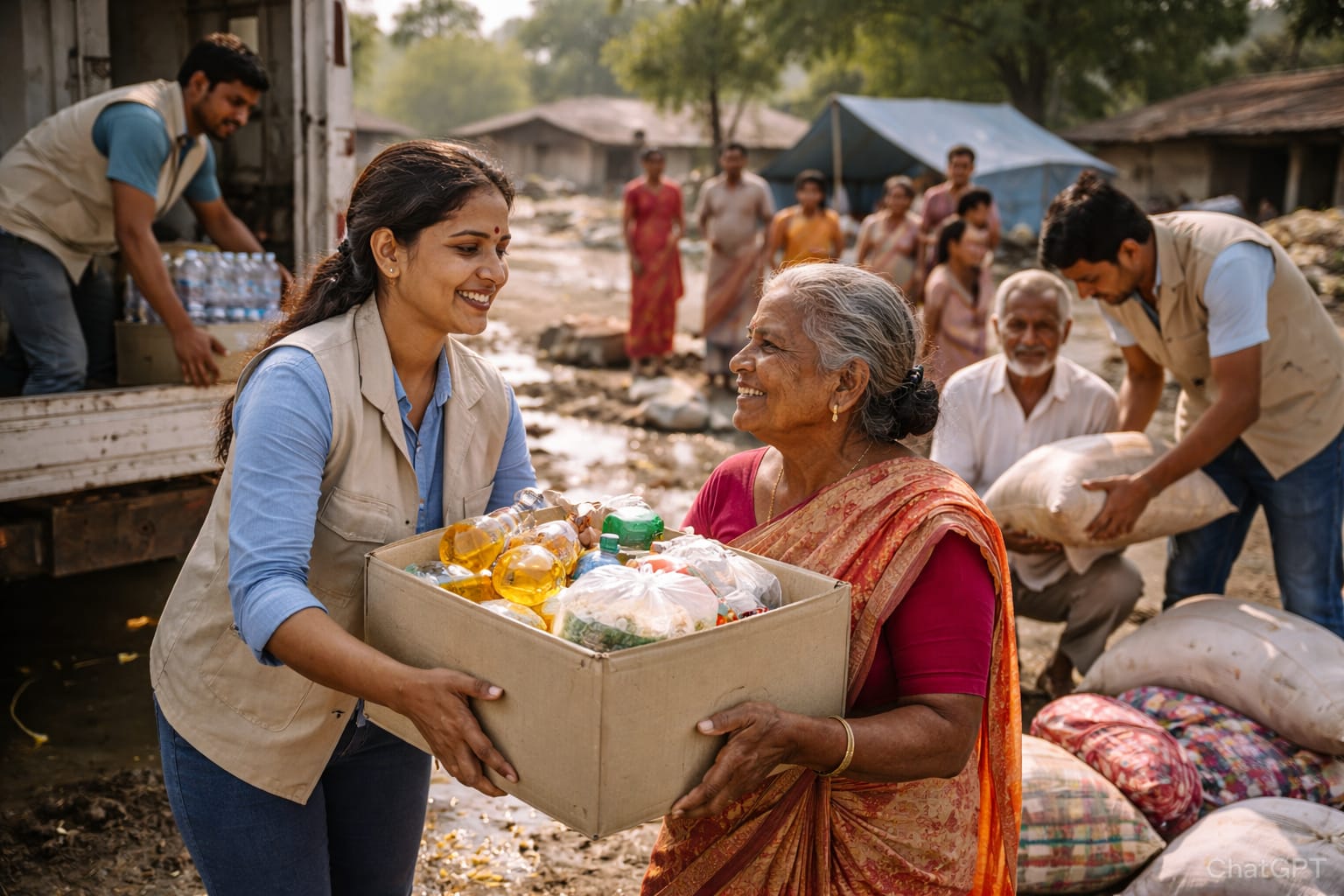
Emergency relief initiatives prioritise rapid mobilisation of essential resources. These may include distribution of food supplies, safe drinking water, clothing, temporary shelter materials, hygiene kits, and basic medical assistance. Coordination with local authorities, community networks, and volunteers ensures that aid reaches affected populations efficiently and responsibly.
Medical relief efforts may involve health camps, essential medicines, and preventive outreach to mitigate secondary risks such as infection, dehydration, or disease outbreaks. Immediate intervention focuses on stabilizing vulnerable individuals and preventing further harm.
However, relief alone does not restore stability. Rehabilitation requires structured, long-term engagement.
Post-crisis support may include assistance in rebuilding homes, restoring livelihoods, re-establishing educational continuity, and facilitating access to healthcare and essential services. Livelihood restoration initiatives aim to reduce prolonged economic dependency by enabling affected individuals to regain income-generating capacity.
Psychological and emotional support is recognized as an important dimension of recovery. Community-based dialogues, awareness sessions, and appropriate referrals help address trauma, stress, and uncertainty that often accompany displacement or loss.
Infrastructure rebuilding may involve collaborative efforts to restore sanitation systems, clean water access, community spaces, and other essential facilities. The objective is not only to reconstruct physical structures but to re-establish community functionality.
Preparedness and resilience-building form an important long-term focus. Awareness programmes on disaster readiness, resource management, and community coordination strengthen local capacity to respond to future emergencies with greater stability. Preventive planning reduces vulnerability and accelerates recovery.
Throughout relief and rehabilitation efforts, dignity remains central. Assistance is provided with respect, transparency, and accountability. Individuals are treated not as passive recipients of aid, but as active participants in rebuilding their circumstances.
The Trust also emphasizes responsible resource management, ensuring that relief operations are organized, well-documented, and aligned with local needs assessments. Sustainable recovery requires coordination, planning, and institutional integrity.
Relief addresses immediate survival. Rehabilitation restores continuity. Together, they protect human stability during moments of disruption.
Through emergency response initiatives, livelihood restoration efforts, infrastructure rebuilding, community partnerships, and resilience-building programmes, the Trust seeks to support affected communities in moving from vulnerability toward renewed strength and stability.
In times of crisis, timely intervention preserves life. In times of rebuilding, sustained commitment restores hope. And in both, collective responsibility strengthens the social fabric.