Contribute toward the service of truth and collective well-being. Click here

- Home
-
About Us ▾
About Us Tattvabodh Trust The Abstract Mission Certificate Founders The Abstract Monk [GD] Aadya Tyagi
- Our Work ▾
-
Impact ▾
Impact Stories The Wisdom Project Human Potential Development Education Healthcare Nutrition Arts, Literature & Aesthetics Culture & Heritage Livelihood Institutions Women & Youth Environment & Energy Relief & Rehabilitation Digital Transformation Social Justice Scholarship Programme
Impact Numbers Our Journey - Wisdom Hub ▾
- Mission 1.5
- Media
- Youtube
- The Abstract Club
- Get Involved
- Contact Us
Institutions &
Centers
An institution becomes sacred when it
serves awakening, not authority.
Overview
Sustained social progress requires structured spaces where knowledge, creativity, reflection, and service can be cultivated over time. Institutions provide continuity beyond individual efforts. They create environments where learning, research, dialogue, and cultural expression can mature with stability and direction.
The Trust envisions the establishment and support of institutions and centers that serve as long-term foundations for intellectual, social, cultural, and spiritual development.
Educational institutions may be developed to provide holistic learning environments that integrate academic excellence with awareness, critical thinking, creativity, and civic responsibility. Such institutions aim not only to transmit information, but to cultivate discernment, character, and social consciousness.
Life education centers may focus on practical wisdom—financial literacy, health awareness, emotional resilience, communication skills, ecological responsibility, and ethical decision-making. These centers bridge the gap between formal education and lived experience, equipping individuals with tools for balanced and responsible living.
Research centers form another critical dimension. Dedicated spaces for interdisciplinary research in philosophy, social sciences, environmental studies, digital innovation, culture, public policy, and sustainable development may be established to generate evidence-based insights and informed solutions. Research initiatives contribute to long-term policy relevance and intellectual credibility.
Meditation and contemplative centers may be developed as environments for reflection, mental clarity, and inner stability. Such spaces encourage disciplined inquiry into consciousness, attention, and ethical awareness. They are designed not as sectarian institutions, but as platforms for contemplative practice, dialogue, and psychological well-being.
Art and music galleries, cultural forums, and performance spaces may serve as platforms for creative expression and aesthetic refinement. Supporting visual arts, classical and contemporary music, literature, theatre, and cultural dialogue strengthens creative ecosystems and preserves artistic heritage. These centers may also host exhibitions, recitals, lectures, and collaborative workshops.
Cultural and intellectual centers, including public and research libraries, may facilitate study circles, manuscript preservation projects, philosophical dialogues, language learning initiatives, and intergenerational knowledge exchange. Well-curated libraries—both physical and digital—serve as repositories of literature, philosophy, science, history, and spiritual texts, providing open access to knowledge and supporting lifelong learning.
Community centers may provide accessible platforms for vocational training, youth engagement, women’s empowerment initiatives, digital literacy programmes, and local development projects. Decentralised centers ensure inclusion across urban and rural regions.
Hybrid models integrating physical infrastructure with digital platforms may extend access beyond geographic limitations. Online learning portals, digital archives, research repositories, and virtual discussion forums enhance outreach and continuity.
Institutional sustainability remains essential. Governance frameworks, transparency mechanisms, academic integrity, financial accountability, and ethical oversight ensure that institutions remain credible and resilient. Long-term impact depends not only on vision, but on structured administration and responsible stewardship.
Partnerships with universities, scholars, artists, community leaders, and technical experts may strengthen interdisciplinary collaboration. Institutions thrive when they remain open to dialogue while grounded in core values.
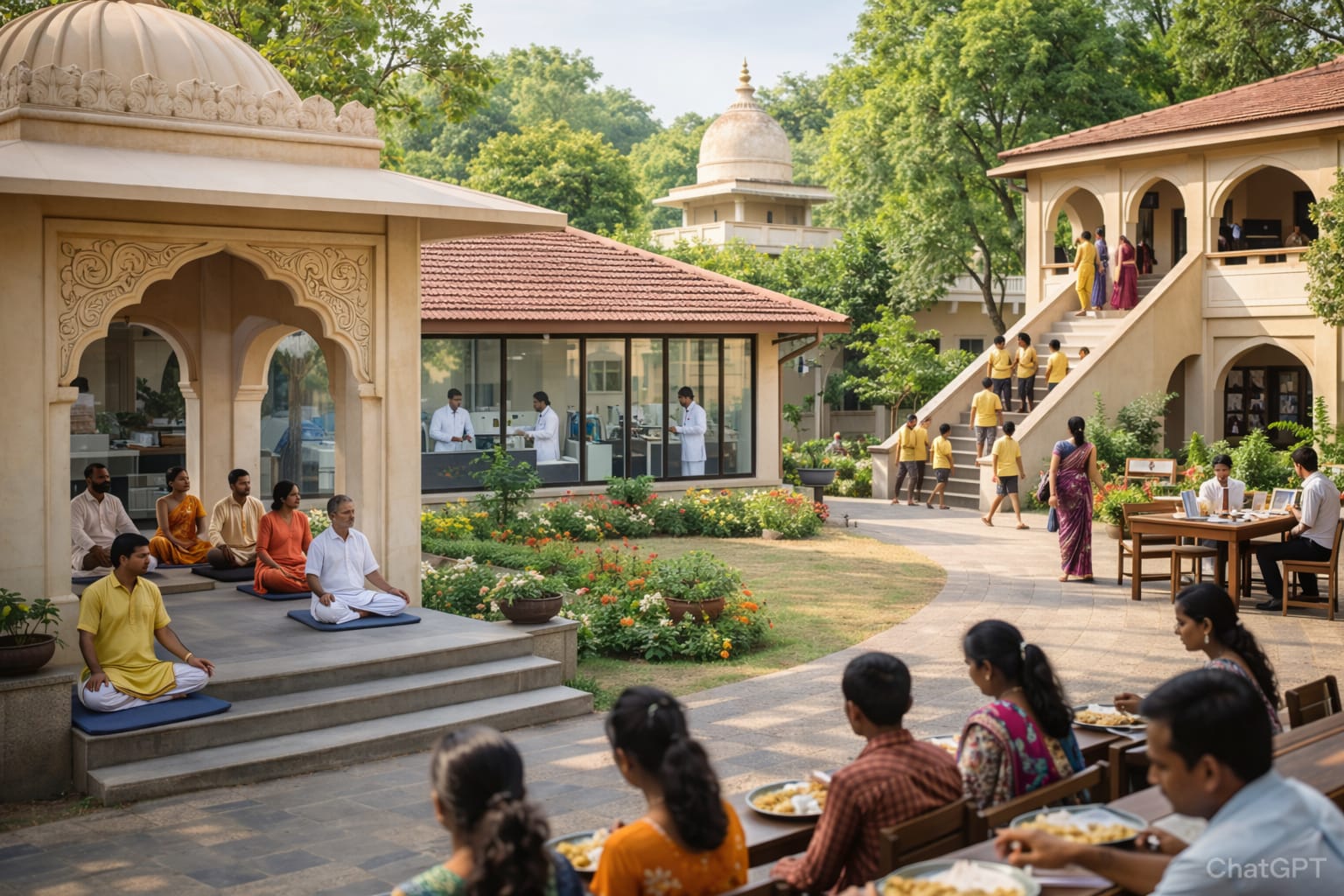
The Trust views institutions not merely as buildings, but as ecosystems of learning, inquiry, creativity, and service. Each center is conceived as a space where knowledge deepens, awareness evolves, culture flourishes, and community bonds are reinforced.
Through the establishment and support of educational institutions, life education centers, libraries, research facilities, contemplative spaces, cultural galleries, and community development hubs, the Trust seeks to create enduring platforms for integrated human development.
When institutions are thoughtfully designed and consciously governed, they become anchors of stability. They preserve wisdom, nurture talent, generate solutions, and sustain collective growth across generations.